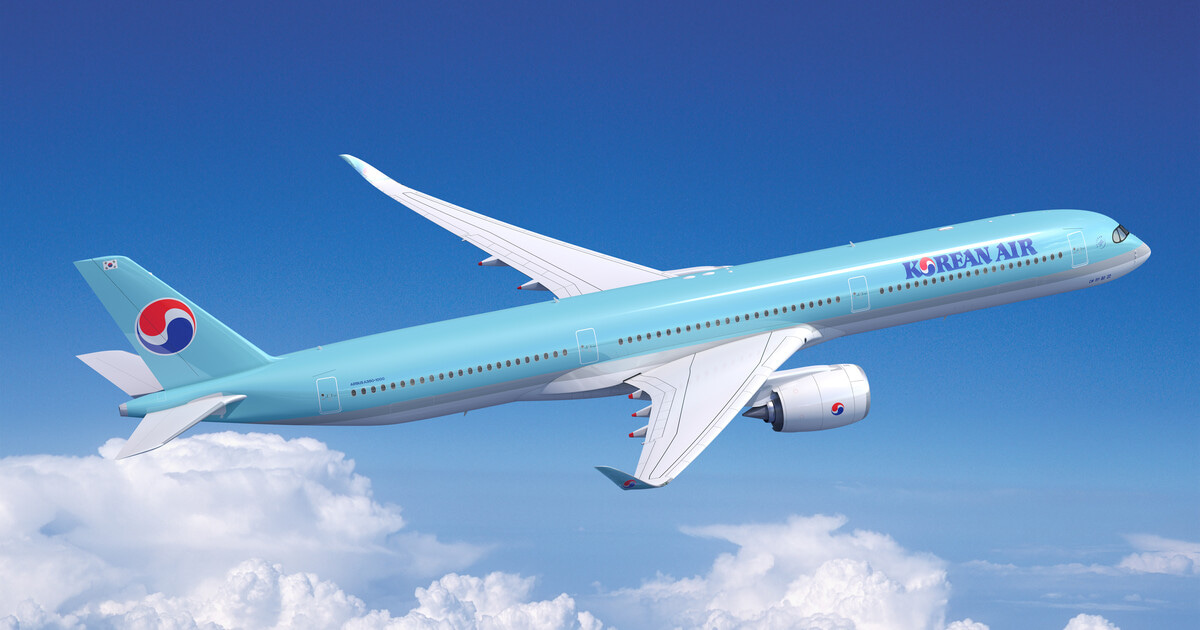
Airbus appears likely to launch a stretched variant of the A350 to compete more head-on with Boeing’s still uncertified 777-9 in the large widebody space. However, when it will pull the trigger on the program and how quickly the twin-engined jet can enter service are open questions.
In October, Airbus Commercial Airplanes CEO Lars Wagner, told reporters in Toulouse that the airliner, if launched, would likely enter service in the early-to-mid-2030s. That means an official program launch would need to come relatively soon, though a decision will not be made before the end of this year.
Generally the same thinking applies for the A220-500, which would represent a longer variant of Airbus’ small narrowbody jet.
“When I travel the world, when I see our customers, the airline CEOs, they’re asking us,” Wagner said. “There’s clearly demand for a longer and stretched A220. There’s clearly demand with our high-tier customers for a longer and stretched A350. So that’s what we our currently designing, thinking about making the business case.”
Market demand would be the force driving any such decision. On the widebody side, Airbus had previously studied the idea of a stretched A350 but determined that the market would not support more than one aircraft of the 777-9's size. But with the global fleets of A380s, 747s and 777 Classics eventually needing replacement—and some airline CEOs calling for next-generation large widebodies—Airbus has been revisiting the concept of a stretched A350 airframe.
In the short term, Airbus' widebody segment is focused on certification and service-entry of the A350 Freighter. Launching a stretched passenger variant—sometimes unofficially called the A350-2000—is likely on the back burner until those A350F milestones are met potentially as soon as late next year.
Perhaps the most interesting question is how a potential A350-2000 model would be powered. Wagner acknowledged in a scrum with reporters that the still-conceptual aircraft would need to be re-engined.
Engine Partner Unidentified
Wagner declined to specify whether Airbus is engaged with GE Aerospace on potentially supplying engines for the A350-2000. He said that Airbus is happy with Rolls-Royce, which supplies powerplants for Airbus’ present-generation widebody platforms, and that the exclusive partnership “works well" for the A350 family.
But the stretch would need more thrust than the A350-1000's Rolls-Royce Trent XWB-97 engines can provide. And there are limited options for an alternative.
Let's speculate. Ignoring the complicated politics of Airbus partnering with GE Aerospace on a widebody program, one option could be the GE9X engine that powers the 777-9. That massive turbofans has encountered several technical challenges during flight-testing of the 777-9, most notably a variable guide-vane issue and, more recently, a mid-seal durability issue that GE Aerospace executives say has been resolved on newly produced engines.
But it is the only production-ready option delivering the A350-2000's likely thrust and fuel-efficiency requirements.
The GE9X is a 105,000-110,000-pound thrust engine developed specifically for the 777X, and it has demonstrated even higher thrust capabilities during testing.
The XWB-97 sits in the 97,000-pound thrust class. It has struggled with the dry, hot and dusty environments in the Middle East, which is notable because Emirates CEO Tim Clark has been among the most-prominent voices calling for larger 777 and A350 variants.
As a purpose-built powerplant for the 777X, the GE9X is not optimized for an A350 airframe. It is also heavier and larger in circumference than the XWB-97. Ground clearance and physical systems integration would need to be assessed, and modifications would surely be required.
Given the long-running widebody engine partnership between Airbus and Rolls-Royce, the enginemaker's in-development UltraFan 80 appears to be a more likely option for the A350-2000 on paper. But it is not a production-ready alternative and demonstrated only 85,000 pounds of thrust during an initial round of testing in November 2023.
Rolls-Royce says the UltraFan 80, based on a geared-ducted architecture, could deliver a 10% fuel-efficiency gain over the Trent XWB and would be 100% compatible with sustainable aviation fuel. However, the powerplant is still under development, with a second round of testing planned for later this year. The enginemaker has not yet confirmed whether the second test campaign is underway, nor has it released updated thrust figures for the UltraFan 80.
Commercial 'Time Horizons'
Understanding Wagner's strategy helps place when an A350 stretch might be delivered. When Wagner succeeded Christian Scherer as CEO of Airbus’ commercial segment on January 1, he implemented an agenda based on three “time horizons."
"We have the execute horizon, we have the enable horizon, and we have the prepare/future horizon,” he said. “Execute is obviously all about delivery. It’s all about quality. It's all about ramping up our operation. It's all about embracing our partners in the supply chain because we need the whole ecosystem to deliver on the ambition that we have.”
An example of an “execute” item would be Airbus’ full-year target of delivering about 870 aircraft to airlines. Wagner expresses confidence in hitting that target despite lagging the pace for the year's first nine months; Airbus had delivered 547 jets to airlines as of September 30. Airbus typically has a surge in deliveries in the fourth quarter, though the gap is still significant enough to question how much ground the airframer can make up in the final three months of 2026.
But this year's production target is more of short-term consideration. The “enable” part of Wagner’s plan includes medium-term goals, such as ramping up production rates across the A220, A320, A330 and A350 programs.
Launching the potential A350 stretch is grouped into the “enable” bucket, which Wagner said encompasses all commercial initiatives within a five-year timeframe.
A350 Production Ramp
Airbus plans to ramp up production to 12 A350s monthly by 2028. But there is no runway beyond that target, as 12 monthly A350s are the upper limit of the airframer's current production system.
Demand for international flights is booming despite persistently elevated jet fuel prices, and airlines want more-efficient long-haul jets. Tellingly, the A350 program is sold out well into the 2030s.
Pushing past the 12/monthly rate becomes another obvious medium-term goal for Airbus. Wagner described that decision in similar terms to eventually launching A220 and A350 stretches.
“The decision for an increased rate on the A350 is inevitable,” he said. “We’re going to do it because the market clearly demands for more action. But it’s a big decision, so we need to bring it to the board of directors. But this is going to happen sooner rather than later.”
Airbus has not been anywhere close to averaging 12 monthly deliveries so far this year, as it delivered 38 A350s to airlines through September 30, and handed over only three units in September.
Given the demand environment and Airbus’ current constraints, the airframer will almost certainly open another final assembly line for the A350. Wagner declined to specify whether that line would be located in France or elsewhere.
Julien Puyou, head of the A330 and A350 programs, echoed the idea that demand for long-haul flights will eventually necessitate more industrial capacity to support the A350 program. Airbus currently has a backlog of more than 800 A350s.
"Given the size of the market...we are studying more rates," Puyou said. "No decision has been taken yet; it is too early to tell you how much and when. But it's clearly on our radar because the market needs it."
This article was first published in Leeham News & Analysis, which is set to provide its subscribers with further assessment of Airbus's plans for a possible A350-2000 widebody in Part 2 of the report.
More In Aircraft