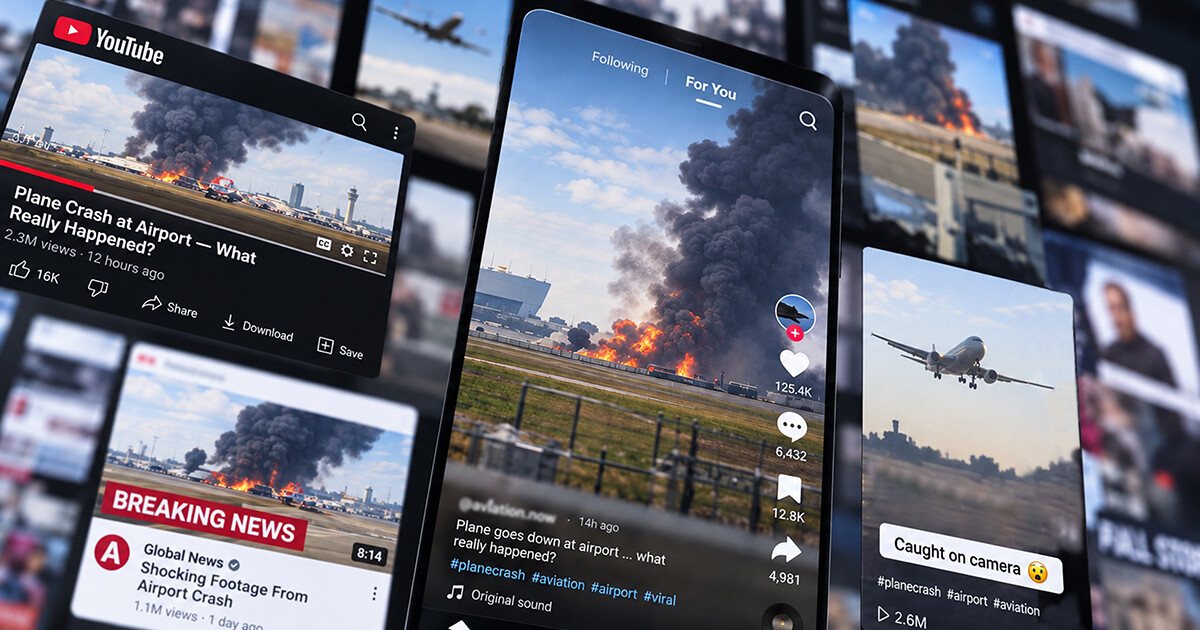
When things go sideways in the age of social media, business aviation operators face a narrow window to shape how a crisis is understood before others step in with their own narratives. What a company does with that critical window has less to do with finding the right words in the moment than with decisions made long before anything happens.
That’s the philosophy Gina Shealy—director of emergency operations for Delaware-based emergency response firm Fireside—brings to her work with aviation brands, treating communication, especially on social media platforms, not as an afterthought but as a trained discipline, built the same way as emergency procedures. That means staffed with backups, rehearsed in advance, and governed by deliberate rules about where a company spends its attention.
And, don’t try to bury the news, said Air Charter Safety Foundation (ACSF) chair and Flexjet chief safety officer Kent Stauffer. He warned attendees at the 2026 ACSF Safety Summit in Daytona Beach, Florida, that organizations can no longer hide after a mishap, hoping it will remain quiet.
“It used to be for a lot of us, back many years ago, if you have an event, you try to see how you can suppress the knowledge of that event,” Stauffer said. “What’s the first thing you do when you have an accident, and you have pictures being taken at the accident scene? You cover the tail number. Wasn’t that the adage?”
Also speaking at the ACSF Safety Summit, Shealy was blunt about why that instinct no longer works. “By the time you get the paint bucket out, there’s already 37 things out on X and a whole re-creation on TikTok,” she said. “That is the opposite of what you should do today.”
Stauffer agreed, “Anytime an airplane diverts, there’s [someone]…who's watching it, who’s already posted it on YouTube.” Most companies don’t ever anticipate this unless they have experienced it, he added.
Shealy offered an approach drawn straight from the cockpit. “Think about those three rules: aviate, navigate, then communicate,” she told AIN. “Communicate is the last one.”
Applied to social media crisis response, “aviating” and “navigating” represent the planning and training that happen long before anything goes wrong. Communicating—the public-facing part everyone thinks of first—is the last piece of the puzzle, productive only if the framework is in place.
Who Speaks and What They Say
Shealy treats crisis communications the way a flight department treats any other operational function: something that has to be planned, staffed, and rehearsed, not assembled after the fact.
She said the most common failure point isn’t a bad message—it’s an unprepared spokesperson or, worse, no spokesperson at all. “You need to have a bench,” Shealy emphasized. “You need to have multiple faces of the company to be able to step in at any time.”
That bench matters, especially when leadership itself is involved in an unthinkable event. Training has to be ongoing, she added, because the media landscape keeps shifting: aviation YouTubers and podcasters have increasingly become the first voices the public turns to after an accident or incident—a role once held by cable news analysts.
Speed is useful only if the substance behind it has already been settled. Shealy recommends pre-drafted, pre-vetted holding statements—reviewed in advance by attorneys, insurers, and leadership—so a company can respond within minutes of an event rather than delaying while negotiating language in real time.
“Have something short and sweet,” she said. “Such as: ‘We are aware of reported events…we’re waiting to get further details from the authorities.’”
What goes into that statement matters as much as how fast it goes out. Shealy is direct about the discipline required in the early hours: “We are confirming facts only in the beginning. So if you don’t know a whole lot, you don’t know a whole lot.”
She is equally direct about language that can undercut an otherwise sincere message. Shealy described a multi-agency briefing where nearly every organization independently reached for the same phrase—“thoughts and prayers”—and how the repetition drained it of meaning.
“As much as that sentiment may be very, very true—that you really are thinking and praying—it has very much become tone-deaf,” she said. “At the end of the day, do the families or the victims really care about your thoughts and prayers? Yes, you want to be a kind, caring, compassionate organization, but that sentiment is reflected more in what you are doing for the people involved in the response.”
That distinction extends to one of the more legally fraught words in a crisis: “sorry.” Shealy separates expressing regret from admitting fault: “You can be sorry that something happened. You can be sorry that this event occurred, or someone’s injured. That doesn’t necessarily mean admitting fault. A lot of times, working with victims and survivors, we hear, ‘I just wish somebody would have said they’re sorry.’”
How to Sustain the Response
Neither Stauffer nor Shealy argues for engaging every critical voice online. Shealy frames it as a resource question: “Where’s your time, effort, and energy going? What’s your [return on investment] on that?” Companies that get pulled into refuting every rumor, she said, lose sight of where their energy actually belongs: supporting the response itself, not fighting for the last word.
Stauffer put it more bluntly, joking that operators no longer need the NTSB “because we’ve got plenty of internet sleuths that’ll solve this problem.” The instinct to fight back against speculation, both suggested, is usually a losing proposition.
That doesn’t mean going quiet after the first statement, they said. Shealy warned that companies often lose ground not in the first hours but in the days after an aviation accident or crisis event, when adrenaline fades and attention scatters. “If you’ve put out an initial statement and you’ve never gone back to update it after 24 hours, 48 hours, that’s not great either,” she noted.
According to Shaely, messaging should also be tailored by channel: making LinkedIn more business-focused; “reaching the public first” on X (née Twitter); and issuing press releases and holding press conferences that are more formal in scope. And, she said, this has to run in both directions internally, so frontline employees are informed early enough that they aren’t blindsided, and so no one inadvertently posts something on their personal social media that undercuts the company message.
None of it is instinctive, Shealy said, adding that crisis response has to be built and practiced before it’s needed—the same way pilots drill for emergencies they hope never to face. “The first mistake is thinking it could never happen to you,” she concluded.
In her experience, the companies that come through a crisis intact aren’t the ones that avoid every misstep. She said they’re the ones that already worked to aviate and navigate before the moment came to communicate.
In this article
More In Accidents