Eurocontrol has cut its growth forecast for this year due to the ongoing impact of geopolitical conflicts on air traffic. Vanessa Hicter, the European air traffic management agency’s senior forecaster, told attendees at EBAA’s AirOps conference today that the Iran war alone has resulted in 110,000 fewer aircraft movements—90,000 arrivals and departures at European airports and 20,000 overflights.
The latest projection assumes that the crisis could ease in early 2027, which could mitigate the spike in jet fuel prices. As of October, Europe’s air transport sector faced per-barrel costs of $196, which was $9 higher than the global average.
“We are in a volatile and risky moment, making it very complex to be a forecaster,” Hicter said at the conference, which is part of EBAA Week held this week in Brussels. She added that the 1% cut in traffic growth for this year—1.7% versus the earlier prediction of 2.7%—is partly based on declining gross domestic product projections for European economies.
Despite the downturn, Eurocontrol still expects that airport capacity across the continent will be insufficient by 2032—to the extent that around 165,000 flights will be “unaccommodated.” This is expected to limit scheduled flight growth at airports served by airlines, which could potentially boost demand for business aviation alternatives.
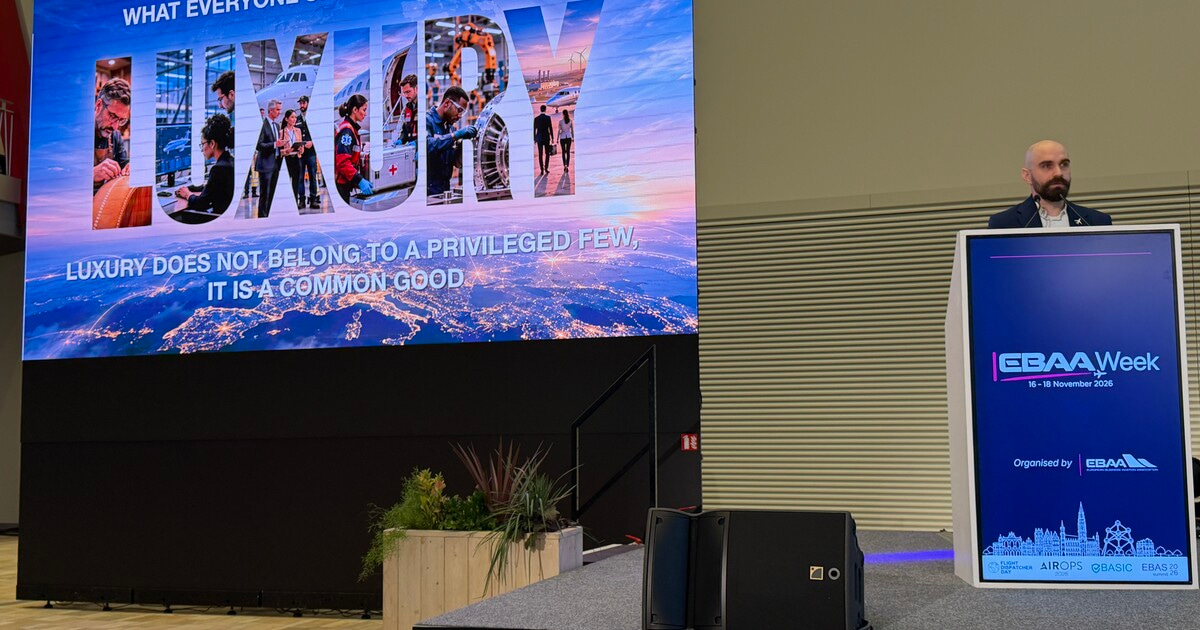
In the “State of the Industry” session, EBAA corporate secretary Arthur Thomas told attendees that business aviation needs to embrace the word “luxury” that is so often used in attacks on the sector on environmental grounds. He argued that luxury can be redefined to sidestep images of entitled indulgence for the rich and famous.
“Luxury is not a privilege we consume; it is a capability we collectively possess, covering healthcare, jobs, innovation, connectivity, and competitiveness,” Thomas said. “Prestige and lifecycle are part of what is being sold, but it is also about comfort, flexibility, and time savings. We are a luxury product for the common good; a luxury for the common good.”
According to Thomas, his reframing of luxury is backed up by data from the last 12 months showing that business aviation provides access to 1,000 more European airports not served by the airlines, and with 80,000 unique routes served by around 4,000 aircraft.
EBAA research has identified a €100 billion impact from the sector on the European economy, supporting up to 430,000 jobs directly or indirectly. Direct employment in the business aviation segment includes 40,000 positions with aircraft operators, 40,000 in manufacturing, and 12,000 in maintenance, repair, and overhaul.
Europe’s largest business aviation ecosystems are in France, where operators provide access to 218 airports without scheduled flight connections, followed by Germany (179) and the UK (100). Year-to-date traffic data for the sector shows a decline of 1% and 5%, respectively, in France and Germany, with the UK flat and Italy and Switzerland achieving 2% growth, topped by 5% in Spain.
Despite the erosion in France—caused in part by the country’s per-seat “solidarity tax” on flights—Paris Le Bourget Airport (LFPB) has held its position as Europe’s busiest business aviation hub, with movements up 3%, to 48,710, year-to-date and a projected year-end total of 58,227. The continent’s top five airports also include Nice Côte d’Azur (LFMN), Geneva (LSGG), Farnborough (EGLF), and Milan Linate (LIML).
Through October, business aircraft movements have held steady or slightly increased between Europe and both North and South America, as well as Africa and Asia. Apart from the long-standing block on Russian traffic (with some flights continuing to and from Turkey), this year has also seen a marked decline in the Middle East.
Despite these fluctuations, Thomas said EBAA expects business aviation activity to achieve 1% overall growth in 2026. He said this reflects the stability the sector has achieved since the post-Covid boom cycle.
More In ATC