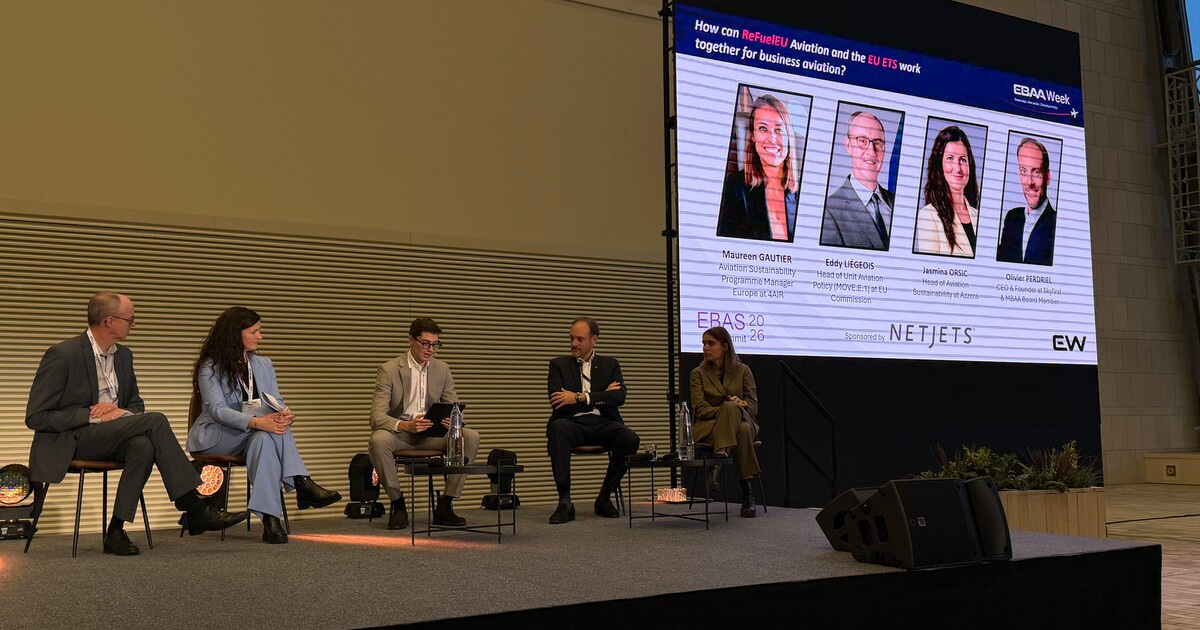
European business aviation executives pushed back strongly against escalating costs and restrictions they say threaten their industry’s viability. At the European Business Aviation Summit in Brussels on Tuesday, European Commission (EC) head of aviation policy Eddy Liégeois heard pleas to rethink the proposed extension of the European Union Emissions Trading Scheme (EU-ETS), as well as complaints about how anti-tankering rules are applied under the ReFuelEU policy.
Plans call to lower the threshold for EU-ETS reporting to aircraft operators emitting at least 1,000 tonnes—or perhaps even 250 tonnes—of carbon dioxide each year would affect hundreds of smaller companies. But even more controversially, the EC wants to withdraw all allowances for using sustainable aviation fuel (SAF) from business aviation.
“This is a punishment that takes us out of the system specifically intended to encourage SAF use,” said Olivier Perdriel, CEO of Malta-based charter operator Skyfirst. “None of this money [paid for EU-ETS and ReFuelEU compliance] goes to sustainability. We are paying money just to make other people rich. We are OK with paying, but we need to know where the money is going.”
Liégeois acknowledged that the EC’s objective in making changes is “to cover as many business aircraft operators as possible” on the basis that their emissions per passenger are high compared with the airlines. During the same conference under the broader EBAA Week event, the International Business Aviation Council proposed a new vehicle tonne kilometer metric assessing payload rather than passengers as what it said would be a more relevant assessment of charges due.
According to sources close to negotiations with the EC, the latest draft version of the EU-ETS proposals would restore the SAF allowances to business aviation. However, if correct, this is no guarantee that the change will apply to the final rules, which must also be approved by the European Parliament.
Anti-Tankering Headaches
ReFuelEU’s anti-tankering rules are intended to discourage operators from arriving at European airports with excess fuel purchased at their point of departure to avoid higher charges at the destination. Cost factors apart, business aircraft operators have found this unduly burdensome in cases where refuelling during short stops at some airports is impractical or even impossible.
Liégeois acknowledged that these rules may be reconsidered as “implementation has gone beyond the objectives,” resulting in officials receiving “thousands of requests for exemptions.” While defending the core concept of ReFuelEU, he said policy details will be reviewed in the second half of 2027.
According to Perdriel, anti-tankering requirements can add an average of up to €30,000 in annual costs for a small operator, potentially prompting cost-cutting measures that could affect safety. “Fuel companies are exploiting this rule, and we have no power to challenge it because they often have a monopoly [at some airports], so the regulators need to check that, too,” he said.
The widening application of EU-ETS is expected to increase difficulties for operators handling both a complex reporting process and recovering costs from their customers. According to Perdriel, invoices for EU-ETS charges coming a year after the flight makes it hard for operators to then seek payment from clients. He said it might take a year for some smaller operators to realize they are subject to EU-ETS, and then there could be another year delay in the billing process.
According to Maureen Gautier, 4Air’s aviation sustainability program manager for Europe, the extension of EU-ETS will bring at least another 400 operators into the system. “Most will not have many aircraft or large teams, but they will have to start allocating resources [to compliance],” she explained. “They need to start speaking to their national authority, open an account with the ETS registry, start tracking fuel for different routes, and allocate budget to pay for their allowances.”
The EC is also proposing to apply EU-ETS to all flights into Europe originating at airports within 5,000 kilometers of Frankfurt, Germany. Gautier predicted that compliance will be even harder for foreign operators that will have to find out which national authority they are required to report to by 2029.
Jasmina Orsic, head of aviation sustainability at Azzera, which like 4Air helps operators with ETS compliance, predicted that typical operators captured by the extended scope could see their costs double. She underlined that business aviation will continue to be disproportionately affected by the policy, which Liégeois had acknowledged was the EC’s express intention.
“If the goal of these policies is really to accelerate the uptake of SAF, then operators paying for it should be able to claim allowances under the ETS,” she said. “Going forward it must be a level playing field; if you are paying into the ETS fund you should get the allowances, which are already limited just to commercial operations.”
Defining Political Battle
Róman Kok, EBAA’s head of public and industry affairs, described ETS reform as “a defining political battle” for the business aviation sector. Describing the political atmosphere in the EU capital of Brussels as defined by “pressure, uncertainty and competing priorities,” he said the industry is committed to contributing to the dual objectives of environmental sustainability and economic competitiveness.
Calling on the EC not to penalize business aviation for being early SAF adopters, Kok demanded equal treatment for EBAA’s members. “It is about ensuring that two operators conducting comparable flights do not face fundamentally different regulatory obligations simply because of how their operators are classified,” he said. “We are not opposing environmental ambition; we are opposing discrimination and unnecessary complexity.”
EBAA is also engaged in the EC’s drafting of a new European Aviation and Aeronautics Strategy that Kok said could deliver “a more coherent European vision” rather than addressing the industry through individual regulations. “The vision should recognize aviation’s economic value, its contribution to connectivity, and its importance to European competitiveness,” he noted. “Business aviation must be part of that vision and not an afterthought.”
The Brussels-based industry group is also focused on anticipated changes to the EU’s Air Services Regulation next year. This could reform how Europe’s aviation market functions, with EBAA eager to ensure that any changes “reflect the diversity of operators and business models within it.”
Airport access and the application of slot requirements have also resurfaced as a threat to business aviation’s ability to operate flexibly. “At many European airports, capacity constraints and increasingly restrictive conditions are making operations more difficult,” Kok concluded.
More In Sustainability and Environment