The FAA needs to continue to evolve from a “transactional” to a “high-risk oversight” approach to certification to pave a path for new products to reach market, according to Gulfstream Aerospace president Mark Burns.
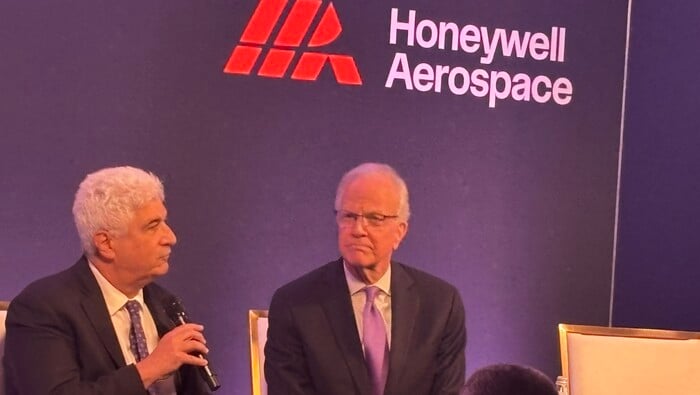
“The message to Transportation Secretary [Sean] Duffy is: Let’s go from a transactional day-to-day. Let’s make sure we cover the entire rulebook to what are the best safety outcomes based on our understanding of what the high-risk maneuvers are in this,” Burns said yesterday at the Honeywell Aerospace’s American Aviation Leadership Summit in Washington, D.C. “I believe as a leader in the world of aviation, that it’s important not just to have good quality decisions, but to make those decisions in a timely manner. That allows you to innovate.”
Burns explained that when Gulfstream embarked upon a new family of aircraft in 2014, it decided to bring five models to market that would offer commonality: the G400, G500, G600, G700, and G800. They share similar flight decks, fly-by-wire systems, and maintenance procedures.
“We were thinking beyond the next airplane, but really about the life cycle of a family,” he said. “We ask ourselves what all the aspects of lifetime ownership of an airplane are, from the very beginning of the design to how we manufacture…and then how do we ensure that airplane operates safely for the next 50 years. That became a real foundational moment for us.”
Early on, Gulfstream brought regulators into the fold to provide insight on its plans. “We needed to explain to them what we’re doing because we’ve never done it before,” Burn said. “And probably no one had tried to build five different airplanes kind of simultaneously, but we did that based on commonality of design, commonality of manufacturing, a commonality of training, and things of that nature.”
This was a learning experience for Gulfstream as the Savannah, Georgia manufacturer worked through the certification process. The company has since certified four of those models—the G500, G600, G700, and G800.
“We learned a lot about the process, and it is a very transactional process,” Burns said. But working with the FAA, Gulfstream was hoping to move it toward risk management. “That means not going from just checking every box that’s in the rulebook, but how do you have the FAA take oversight of the high-risk portions of testing and let the OEMs focus on the more routine things that we’re going to do over and over and over again for five different model airplanes.”
As Gulfstream certified the G500, G600, and G700, each time was like starting over, Burns said. “We were building a very common platform, but we were starting over because that’s the transactional nature,” he said. But when the company got to the G800, it was a different process, Burns continued, “one that I think was more collaborative and certainly focused on high-risk issues with the airplane.”
This requires trust between the regulators and OEMs, he said, adding that trust is a two-way street stemming from transparency and candor. He acknowledged that the FAA may not like all of Gulfstream’s approaches, but there also may be moves by the FAA that don’t make sense to Gulfstream. “We need to be able to have a very candid conversation about that,” he said.
Gulfstream was the first aircraft manufacturer to establish an organization designation authorization (ODA), Burns noted. That ODA began in 2008 with about a dozen people and has grown to almost 600.
For the FAA to embrace the ODA process, it needs to delegate. That’s where not only trust and transparency come in, but also understanding the maturity of the ODA. “We’ve matured that process over the many years, and I think it’s important that the FAA look and understand the maturity of every organization because not all ODAs are created equal,” he said. “So transactional to a high-risk oversight is the real opportunity in front of us.”
In this article
More In Regulations and Government