At some Bombardier service centers, it now costs the airframer more to provide an hour of technician labor than it charges customers for that time, a senior aftermarket executive with the company said last week. The disclosure at the Corporate Jet Investor Miami conference illustrated the margin pressure facing OEM and independent maintenance providers alike.
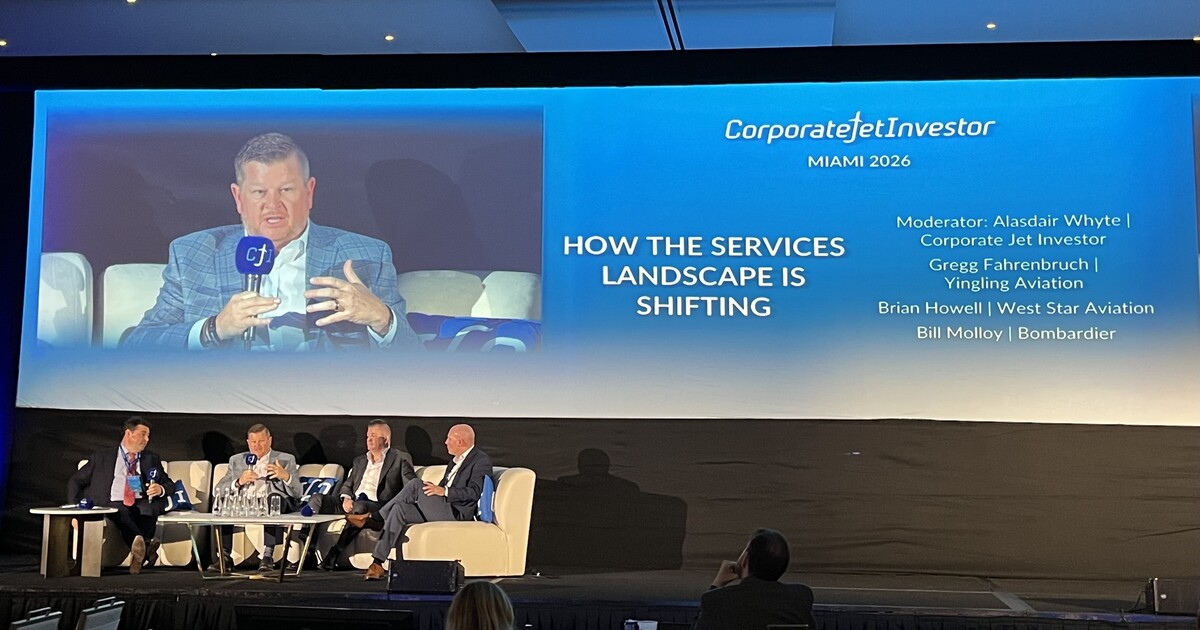
“Our wrap rate in some service centers is higher than our labor rate that we charge a customer,” Bill Molloy, Bombardier’s v-p of aftermarket sales and parts services, told the conference. Molloy appeared alongside Brian Howell, chief commercial officer of West Star Aviation, and Gregg Fahrenbruch, CEO of Yingling Aviation, on a panel moderated by Corporate Jet Investor’s Alasdair Whyte that examined labor, supply-chain constraints, private equity investment, and the evolving relationship between airframers and independent MROs.
Costs vs. Pricing
Howell said West Star’s analysis shows labor costs climbing about 6% annually since 2020, with no corresponding rise in what shops can charge. “We’re not getting that revenue; we’re not getting 6% more per year,” he said.
According to Molloy, the escalation of the past several years makes it “hard to justify passing all of that on to the end customer,” forcing Bombardier to scrutinize its cost structure. He called that effort “a big, big focus within Bombardier right now.”
Fahrenbruch described the same dynamic at Yingling, noting that competitive bidding prevents shops from recovering higher wages through price. He said independents will need to offset the gap through scale, innovation, and efficiency.
Consolidation
Molloy traced Bombardier’s current service strategy to 2016, when the company launched a campaign under the slogan “Bring your jets home” to draw maintenance work back to its own facilities. “At that time we had 64 authorized service facilities all around the world. Today we have 14,” he said, explaining that Bombardier deauthorized many of them because “we wanted to take that risk back ourselves.”
The services business then generated about $700 million annually, and Bombardier set a target of $2 billion. “We passed $2 billion in 2024, a year ahead of schedule,” Molloy said. He cited two motivations: higher aftermarket margins, and the influence that factory service has on future aircraft sales. “When we’re turning the wrench on our own aircraft, we’re creating an impression with our customers,” he said, adding that new-aircraft lead times now run three to four years.
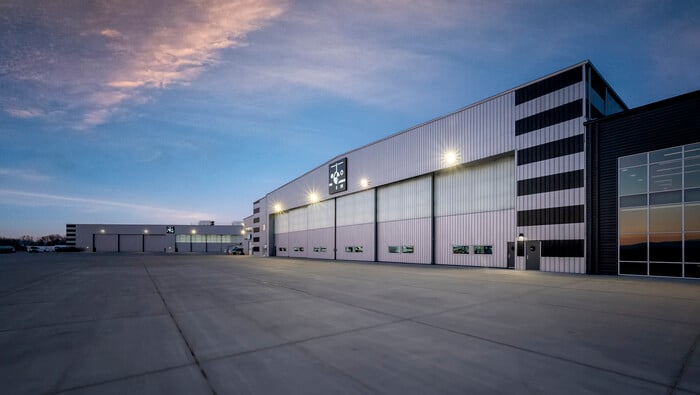
Bombardier has added roughly 1.2 million hours of annual service capacity over the past three to four years, according to Molloy, and recently opened a service center in Fort Wayne, Indiana. He said the company will open a new facility in Abu Dhabi probably by the middle of 2027, bringing its company-owned network to 12 service centers. The Canadian manufacturer previously had targeted a 2026 opening for the Abu Dhabi facility at Al Bateen Executive Airport.
Despite the consolidation, the independent MRO executives on the panel described a cooperative relationship with the airframer. Howell said West Star was among the shops that “at some point during this rationalization got deauthorized,” but it continues to purchase a significant volume of Bombardier parts. “West Star today benefits from the work that the Bombardier team did to get those parts loosened up,” he commented.
Fahrenbruch said Bombardier’s procurement staff “fight for the third-party MROs just as hard as they fight internally,” adding, “it’s not an us-versus-them thing.”
Bombardier expects a growing role for outside partners as its fleet ages. “By 2030, we will have close to 2,500 aircraft that will be aged 20 years old,” Molloy said. The company is assessing what support network those aircraft will require and wants any partners it brings in to “deliver the service that’s in line with our brand.” Referring to West Star and Duncan Aviation, he said, “they compete against us on a day-to-day basis, but they’re also amazing customers of ours.”
Supply Chain and Workforce
During the Covid pandemic, Bombardier created an intervention analyst role and now has more than 50 such staff stationed on site at key suppliers. “I used to look at probably 50 to 70 problematic parts every single day. Now I’m looking at 15,” Molloy said, while cautioning, “I’m not here saying that we cracked it.”
Howell said component turnaround remains a significant source of downtime. He cited “big, big, big airplanes right now that are 8 years old where the landing gear is an eight-month or 10-month experience,” noting, “It’s not a Bombardier aircraft.” He added that he has seen operators part out airplanes as young as 5 to 8 years old, though he did not identify specific types or owners.
To gain more control over cost and schedule, West Star has invested in off-wing capabilities, including engineering services for large flight departments and landing gear work for Embraer aircraft, Howell said.
Molloy said the average age of the technician workforce is now “well in the 50s.” Bombardier has responded with apprenticeships, a fast-track A&P certification program launched in Wichita and since expanded to Hartford, Connecticut, and a new learning center in Wichita. He and Howell both said retention presents as much difficulty as hiring.
Fahrenbruch said MROs also compete with other skilled trades. “Heating and air-conditioning companies are offering some of these young kids 50 bucks an hour,” he said. He identified knowledge transfer as a further concern when experienced technicians depart: “We can find someone to fill the seat, but we can’t transfer the knowledge effectively.”
Howell said West Star partly mitigates competition for talent by locating major campuses in smaller markets such as Grand Junction, Colorado, and Chattanooga, Tennessee, rather than Wichita.
Private Equity
Both independent executives said institutional capital has become essential to reaching competitive scale. “We could not have done the growth that we’ve done without our private equity partners,” said Howell, whose company is owned by Greenbriar Equity Group. He said three firms were active in West Star’s most recent sale process and that discussions with investors are now “equally us courting them and them courting us.”
Fahrenbruch, whose company is majority-owned by AE Industrial Partners, said he self-funded Mountain Aviation’s growth “from 12 million to 200 million in a couple of years,” but that replicating that approach in a modern MRO is “physically impossible” given the costs of manuals, tooling, and training. He cautioned that some real estate and infrastructure investors enter the sector expecting quick returns. Hangars and FBOs may suit that model, he said, but “when you start getting into operations and services, it’s a whole different ballgame.”
In this article
More In Maintenance and Modifications