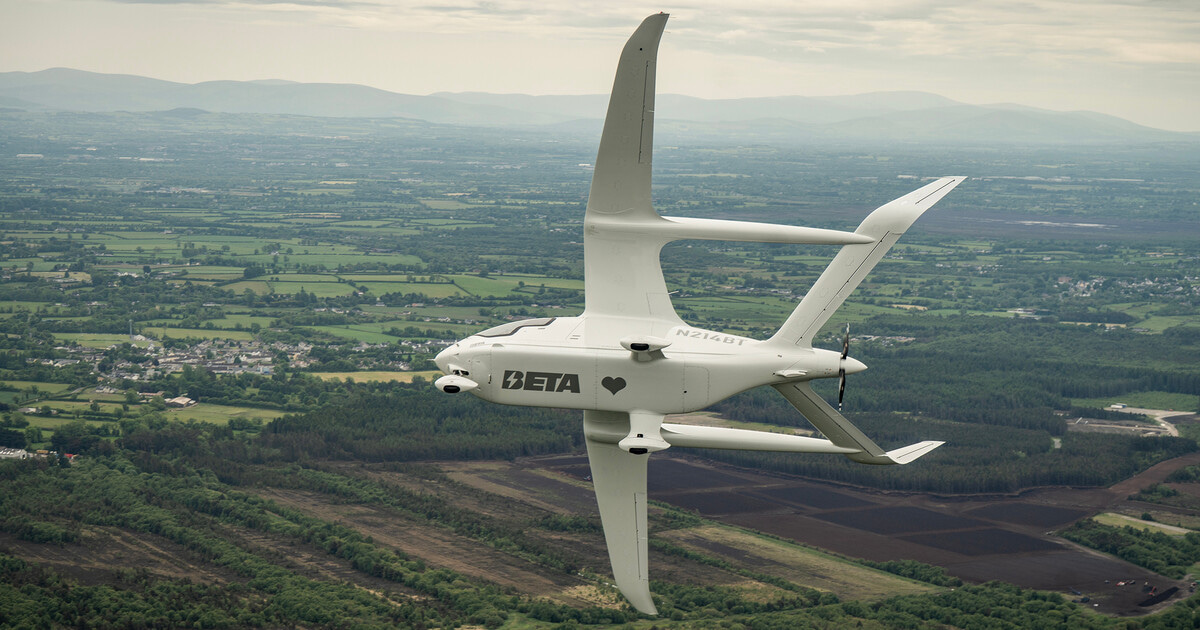
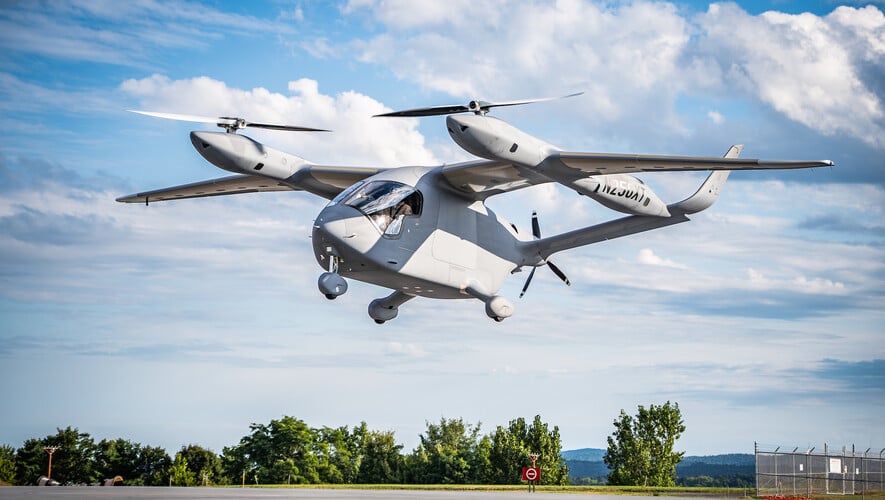
Beta Technologies has focused recent sales of its Alia CX300 electric airplane on aeromedical and cargo customers as high fuel prices continue to squeeze operators, founder and CEO Kyle Clark told investors on November 3. He also predicted that Beta’s Alia 250 will be the first eVTOL aircraft to achieve FAA type certification, though he did not specify a current target for that milestone.
South Burlington, Vermont-based Beta has begun flying in six of its seven projects under the FAA’s eVTOL Integration Pilot Program (eIPP), which allows flights ahead of type certification to generate data for future FAA rules. Beta is also using the flights to show operators potential cost savings.
“Airline customers continue to struggle with high fuel prices and are watching the eIPP missions closely, specifically for the realized cost savings,” Clark said on the company’s third-quarter earnings call. Beta has pegged the Alia CX300’s operating cost at about $450 per hour, compared with $800 to $850 for a turbine-powered Cessna Caravan.
Beta’s Backlog Tops $4 Billion
Commercial aircraft backlog has now reached 1,040 aircraft in firm orders and options worth more than $4 billion. According to Beta chief financial officer Herman Cueto, the orders have been split about 50-50 between the Alia CX300 and the Alia 250. Beta’s CX300 has flown radioisotopes, manufactured organs, medical supplies, mail, and emergency-response equipment, as well as car parts for factories trying to avoid costly production-line stoppages, Clark said.
“These cargo and logistics things, we kind of talk about it abstractly, but buried within that, our economy moves on the things that get to the factories to build the stuff, and we want to be a part of that,” Clark said. He called cargo “a huge and growing market” and “the right entry point” for bringing Beta’s electric aircraft into commercial service. Clark added that one of the orders that pushed the backlog past $4 billion came from a company moving “one of these obscure cargo elements,” and that Beta will announce the deal soon.
Passing the $4 billion backlog benchmark put Beta two months ahead of its 2026 year-end target. The company also passed its goal of 250,000 nm flown and grew its aircraft charging network to 168 sites, exceeding its goal of 150. Other goals for 2026—a demonstrated production rate of 4.5 aircraft per month and FAA certification of its H500A electric motor—are still in progress.
Beta’s earnings presentation cited a maximum demonstrated production rate of 0.5 aircraft per month against a year-end target of 4.5. Clark said component lines for flight control computers, battery packs, wire harnesses, and inverters have demonstrated capacity for 4.5 aircraft per month, and Beta is extending those demonstrations to major airframe structures. He expects the underlying manufacturing infrastructure to be in place by year-end, with “additional rate demonstrations continuing into early 2027.” Beta is not yet staffing for sustained production at that rate, he said, and building conforming flight-test aircraft for certification remains its top manufacturing priority.
Racing Toward FAA Type Certification
FAA certification scorecards in Beta’s third-quarter earnings presentation put the H500A motor at 98% on compliance planning—the third of four phases, in which the FAA accepts test plans—and 45% on the final implementation phase, in which Beta runs those tests and the FAA accepts the results. Those figures are 89% and 5%, respectively, for the Alia CX300, and 6% and 0% for the Alia 250 eVTOL. Last month, Beta applied for an amended type certificate for the H500B variant that will power the Alia 250. The company also sells its motors to other electric aircraft makers, such as Eve Air Mobility, through a components business that Clark said has a $1 billion backlog.
Even with the Alia 250 at 0% implementation, Clark said the eVTOL model, which recently earned an FAA market survey certificate, can still beat rivals to the finish line. “I do firmly believe we will be the first to certify in the VTOL industry,” he said. “And it’s not necessarily because we’re the furthest along; it’s because we have less total to do.” He pointed to design choices such as avoiding thrust vectoring and liquid cooling, as well as certification work on the CX300, which shares about 80% of its design with the Alia 250.
Clark acknowledged that he can’t say with certainty that Beta will be first. Rival eVTOL developers Joby, Archer, and Eve are expected to discuss their certification progress in their own third-quarter earnings calls over the course of the next week.
At NBAA-BACE last month, Clark told AIN that “the VTOL is always about a year behind each of the steps of the CTOL,” referring to the conventional-takeoff-and-landing Alia CX300. He declined to predict certification dates, saying he will discuss what is “within our control” but will “not try and forecast something for the FAA.”
On the defense side, Beta is assembling a second autonomous, hybrid-electric MV250 for contested logistics, with components for a third coming together. Clark said the MV250 will ramp up “slightly ahead” of the Alia 250 and that he expects it to land a rapid-prototyping contract. Cueto said he met with senior Pentagon leaders on October 21 to discuss the MV250’s development, its industrialization timeline, and how it fills a gap in the existing fleet.
Third-quarter revenue nearly doubled to a record $17.7 million, a rise Beta’s filing attributes largely to ground equipment deliveries and engineering services. Beta raised its 2026 revenue forecast to between $52 million and $57 million. It posted a $119.1 million net loss and ended the quarter with $1.34 billion in cash.
In this article
More In Aircraft