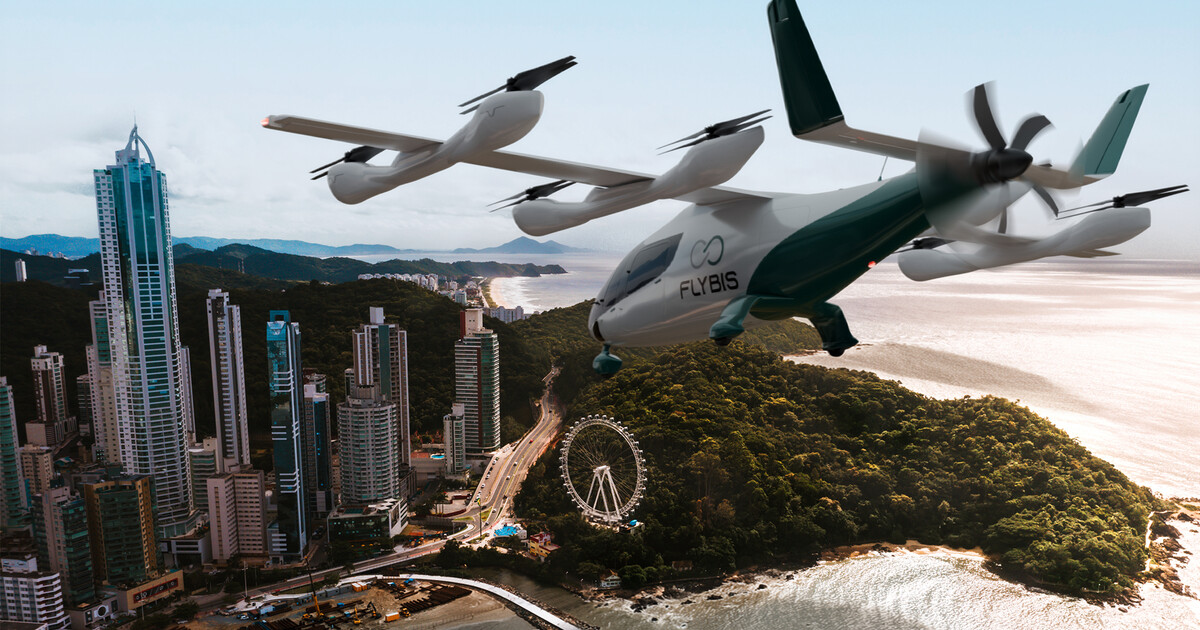
Brazilian air taxi start-up FlyBis has signed a contract for up to 12 of Eve Air Mobility’s eVTOL aircraft. The deal announced on Wednesday was sealed almost four years after a letter of intent in December 2022 and covers two firm orders and purchase rights for 10 more of the four-passenger aircraft.
FlyBis confirmed that it intends to use the Eve-100 aircraft for services in southern Brazil that would connect areas such as Santa Catarina and Rio Grande do Sul. The operator said that the air taxi network might include destinations such as Navegantes, Balneário Camboriú and Florianópolis along Santa Catarina’s coastline and tourist locations including Gramado and Bento Gonçalves in the Rio Grande do Sul mountains.
Eve said its full-scale engineering prototype has now completed 73 test flights, including hover and low-speed exercises, logging just over three hours of total flight time and validating 170 points. It is gradually expanding the flight envelope through to the transition flight stage, including in-flight activation of its rear pusher propulsion system as it advances towards wing-borne flight.
The spin-off from Brazilian airframer Embraer aims to have a conforming prototype ready to fly in the second half of 2027, targeting initial type certification in 2028. In September, Brazil’s Ministry of Ports and Airports met with Eve and multiple stakeholders to discuss plans for vertiports, energy supplies for eVTOL aircraft, operational safety, telecommunications, and airspace integration.
On Thursday, Eve issued its third-quarter financial report, which showed a net loss of $58.1 million, almost 24% higher than the same period in 2025. Net cash used for operating activities was $51.6 million.
The company has started taking delivery of the first parts for six prototypes it will build for the certification process. The lifter motor Nidec Aerospace is developing in Japan has completed testing and should be ready for the conforming aircraft in 2027.
Eve CEO Johann Bordais told an investor call that the first prototype is around eight flights away from achieving a full transition flight at speeds of around 100 knots. In October, it made a partial transition at around 45 knots.
Company CFO Eduardo Couto reported that total cash burn in the first nine months was $170 million, which he said is below earlier forecasts. He said the company has enough capital to work through 2028 without requiring further fundraising.
In this article
More In Aircraft