Bell delivered 29 commercial helicopters in the third quarter, one fewer than a year earlier. In an earnings call on Thursday, the Textron Aviation rotorcraft segment reported revenues at 9% down at $933 million.
The group said the drop came mainly from less work on the U.S. Army’s MV-75 Cheyenne tiltrotor program, which is still in development. Bell slowed spending on the program while it waited for Congress to approve funding, which was resolved only as the period was closing.
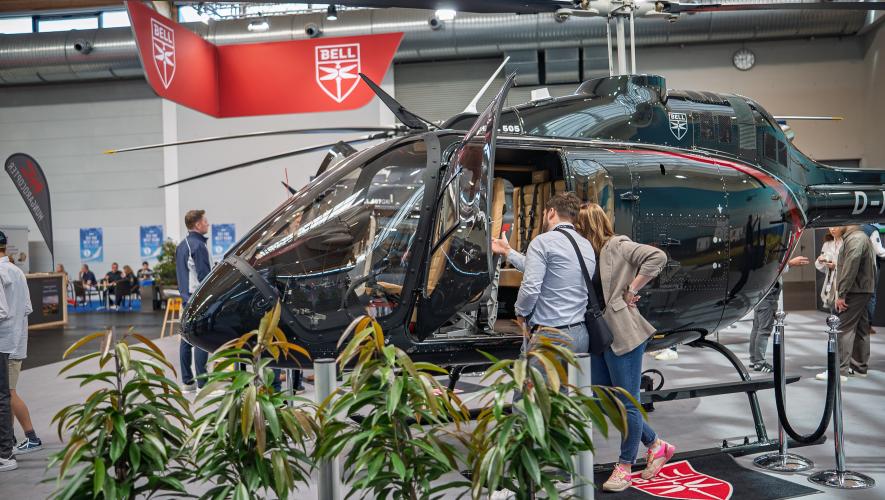
Third-quarter commercial deliveries totaled thirteen 505s, twelve 407s, three 429s, and one 412. In the same period of 2025, Bell handed over fifteen 505s, eight 407s, six 429s, and one 412. Shipments for the 407 were up 50% year over year, while 429 deliveries were cut in half.
Military deliveries consisted of two V-22 Ospreys, matching the third quarter of 2025. Bell delivered no H-1s in either period.
Through the first nine months of 2026, Bell handed over 85 commercial rotorcraft, down from 91 in the same span last year. Year-to-date military deliveries total five V-22 tiltrotors, compared with seven at this point in 2025. Bell’s backlog value stood at $7.6 billion at the end of the quarter.
According to Textron, the $93 million revenue drop from the third quarter of 2025 reflected $59 million in lower military revenues, largely tied to reduced MV-75 volume, along with a $34 million decline in commercial helicopter, parts, and services revenues on lower volume and mix. Segment profit came in at $76 million, down $16 million, or 17%, which the company also attributed primarily to lower volume and mix.
MV-75 Funding Clears Congress
“During the quarter, Bell’s primary focus was on operational continuity of the MV-75 program,” Textron CEO Lisa Atherton said. “The U.S. Army successfully received congressional approval for its ATR requests related to the MV-75 Cheyenne program, mitigating the risks discussed on our last earnings call related to government fiscal year 2026 funding.”
Congress approved a $350 million above-threshold reprogramming (ATR) request covering fiscal year 2026 funding for the tiltrotor, and roughly $300 million was obligated to the program through contract modifications during the quarter, according to CFO David Rosenberg. Atherton explained that the $350 million figure was the government’s estimate of what Bell would need for the quarter, assembled before actual costs were known. Once its approvals were in hand, “the government was able to quickly put on contract mod the $300 million to cover the actuals that we and our suppliers had accrued,” she said, adding that the Army can draw on the remaining funds as supplier invoices come in.
“Throughout the third quarter, we maintained reduced spending levels to mitigate any funding challenges while continuing to advance the program,” Rosenberg said. With the ATR approved, the contract changes in place, and spending held lower, Bell recorded no cumulative catch-up adjustments on the program in the quarter.
Textron said its updated full-year outlook reflects the ATR approval and the contract modifications that followed. The company now expects 2026 adjusted earnings per share of between $6.55 and $6.65, up from $6.40 to $6.60.
2027 Budget
With the U.S. federal government operating under a continuing resolution (CR), Rosenberg said Textron expects “kind of a steady state in Q4, which has already been reflected in the guidance that we’ve shared with you.” Visibility into 2027 will depend on how the funding picture develops as Congress moves from the CR to a full defense budget.
“I think continuing resolutions have obviously become a bit of standard operating procedure that we’ve seen over the past several years,” Atherton said, noting that the current CR expires on December 11. She described the pending fiscal year 2027 budget as “a very healthy budget for the program, reflecting about $2.3 billion for 2027 and supported across the four subcommittees.”
The CR also could delay the award of the low-rate initial production (LRIP) phase of the MV-75 contract, which Textron had expected in the fourth quarter or early next year. “With the start of the fiscal year in a CR, we'd expect a possible push in the timing of the LRIP award,” Rosenberg said.
Cheyenne Takes Shape
Atherton said “the program has made significant progress on the aircraft build.” Bell and its Team Cheyenne partners have completed three wings in Amarillo, Texas, received the first nacelles, and finished the first wing-and-nacelle assembly. The first fuselage has been completed at Bell’s Wichita Assembly Center and is expected to be mated with the wing assembly in the fourth quarter.
Several critical components, including the first gearboxes, also have moved into testing. Those gearboxes are part of the drive system that was assembled in Bell’s new MV-75 drive system test lab in Grand Prairie, Texas.
“We are very excited about the progress made on the program, as the MV-75 remains a top priority for the U.S. military,” Atherton said. “Modern warfare is increasing the speed, complexity, and lethality of the battlefield, making the ability to maneuver more important than ever. The MV-75 will fundamentally transform how the Army moves and projects combat power in that environment.”
H-1 and Supply Chain
Bell won a contract for structural and power upgrades to the H-1 fleet under the SPINE program. Atherton called it “an important modernization program, as H-1s are essential to maintaining attack, strike and utility capabilities within the Marine Corps.”
On the production side, Atherton said Bell continues to certify new suppliers and dual-source critical raw materials for gearboxes and rotor blades, including castings, rotor blade extrusions, and aerospace steel alloys. Bell is also adding its own capacity for problem assemblies—such as chemical processing, paint operations, and complex assemblies—to relieve suppliers and support on-time delivery, while expanding automation across its product lines.
In this article
More In Rotorcraft