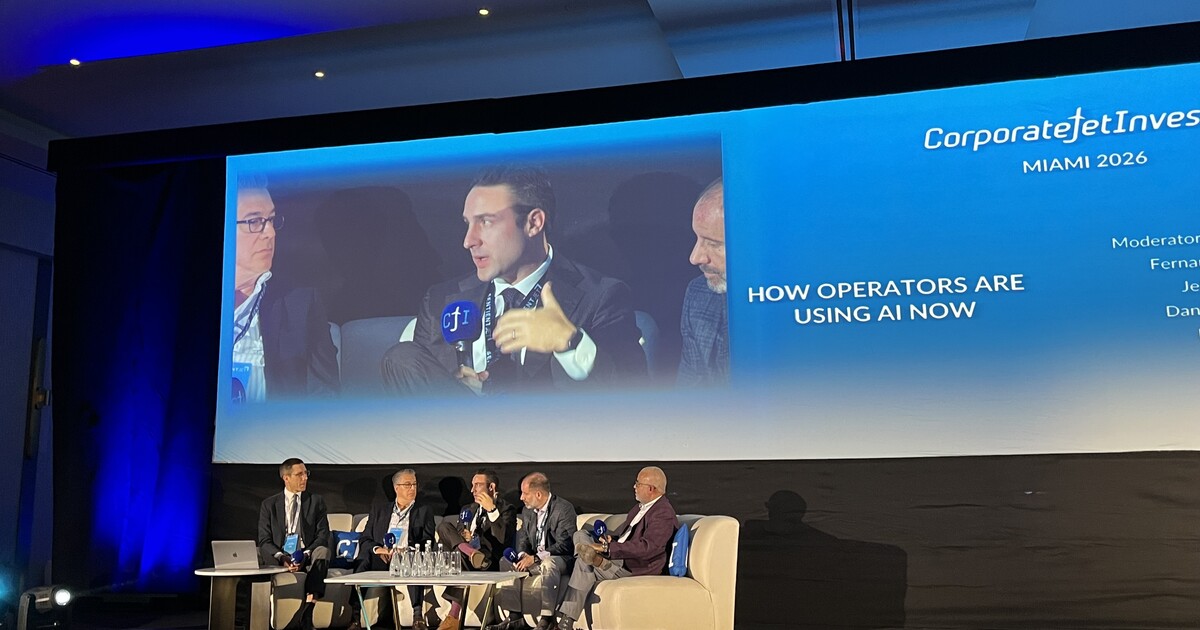
Artificial intelligence (AI) is helping business aviation operators and brokers predict delays, catch problems days earlier, and run leaner teams. But panelists at Corporate Jet Investor Miami on Wednesday warned that AI is the wrong tool for any task that must be right every time.
“AI is probabilistic, and it could be 99.99%, but it’s never going to be 100%,” said Matt Liotta, the chief business officer of air charter firm FlyExclusive. “And in this business, there are things that have to be 100%.”
Liotta made his point with a word game. Say “peanut butter and,” and nearly everyone answers “jelly” without thinking. AI models work the same way: they confidently complete patterns because they have to give an answer. “If I said ‘cleared for runway,’ what number would you pick?” he asked. A person wouldn’t guess, but an AI model will output a number.
“If you need determinism, you can’t let AI do it,” Liotta said. He added that AI can still be told to use a deterministic tool and work with what it returns.
Jeff Reis of MyFlight Advisor said he has used neural networks for about 30 years. From his perspective, generative AI is often more than a problem needs. For go/no-go decisions, he uses a support vector model, and for other tasks he uses simple statistical regression “because it works consistently.”
Simple models like these are predictable, he said, and AI can build them for anyone who has forgotten their statistics. He advised operators to ask first, “What is the problem that we’re trying to solve, and what is the simplest way that I can solve this?”
Don’t Get Comfortable
Liotta said complacency is the bigger danger. He compared adopting AI to getting an instrument rating: at first a pilot feels able to fly through anything, and experience teaches restraint. “Until you have used AI and seen what’s possible and then been burned by it, you don’t really know how to be conservative yet,” Liotta said.
He said he has been burned several times himself. At first, users double-check the answers they get. Then “you get a little bit lazy because it’s always right,” until someone who received your work finds the error. His golden rule: “If you copy and paste something from AI and send it to someone, you better be ready to own it because it’s yours.”
Asked what AI has improved most, Reis named the move “from reactive operations to proactive operations,” with machine-learning models that predict traffic and weather.
At FlyExclusive, a forecasting tool follows how each day is going and projects what happens next. It combines company data with signals from the FAA, NOAA, and ADS-B. It can flag a late flight and the tight turn that will follow. Because it knows where the customer is, it can also tell when the passenger is running late and the delay won’t matter. If a crew tells maintenance control in flight that the aircraft will be grounded after landing, planners can start working around the AOG before it touches down.
“That’s what this is all about, getting out of the drudgery of the work to get into the value of delivering a better experience,” Liotta said.
For Daniel Harris, AI has meant scale. He said his charter brokerage, Ironbird Partners, would probably have needed eight or 10 people three years ago. “We’re running a medium-sized business with three.”
Harris looks for two kinds of work to hand to AI. The first is any problem he never wants to deal with again. Instead of relying on operators to say where an aircraft is, he built ADS-B and FlightAware integrations to track it himself. He also built a weather briefing system that starts watching conditions seven days out.
His notam alerts have caught runway construction and closures a week before trips occur. Harris said operators usually check notams at booking and then about 24 hours before departure. “It’s easier to move plans around seven days before than it would be the day before,” he said.
The second is copying data by hand from one system to another, such as from contracting to accounting. Harris admitted this is “not exactly an AI problem,” but said AI can help build the automation.
Fixing the Process
Nicholas Air chief technology officer Fernando Pineda said the real work comes before any software. “AI or any technology will always amplify what’s already there,” he said, so a weak process just becomes a faster inefficiency. He urged operators to clean up their processes and the handoffs between departments first. Only then should they decide where AI is actually needed, rather than adopting it just to say they have.
Harris said the hardest step is capturing what dispatchers and salespeople know about customers, such as a favorite FBO or caterer, and turning it into rule-based data that AI systems can build on. That means smaller and midsize operators have to change from “very people-focused businesses” to a “process-focused business,” he said. One dispatcher mentioned during the discussion that they are still reluctant to give up that personal touch.
Harris’ method is to write instructions as clearly as he would for an overseas contractor hired through Upwork: the business, the goal, and the steps to get there. The same instructions can then go to a person or to an AI agent.
Moderator Max Van Cauwenberghe, the CEO of scheduling-optimization company RISE, said operators expect economies of scale as they grow but rarely get them because “complexity outgrows the ability to catch up as humans.” He suggested AI could change that, though he said that running a 100-aircraft operation with the resources of a three-aircraft one “might be a little bit extreme.”
Liotta also oversees IT at flyExclusive, and he said guardrails matter as employees start building and downloading tools on their own. “We are a regulated business; we’re publicly traded, some of the information can’t go out to the world,” he said. For example, AI might suggest recording every conversation to transcribe it. “Well, that’s illegal in a lot of places.”
His advice is to ask AI “to be adversarial to itself” and to point out what you’re missing.
More In Operations