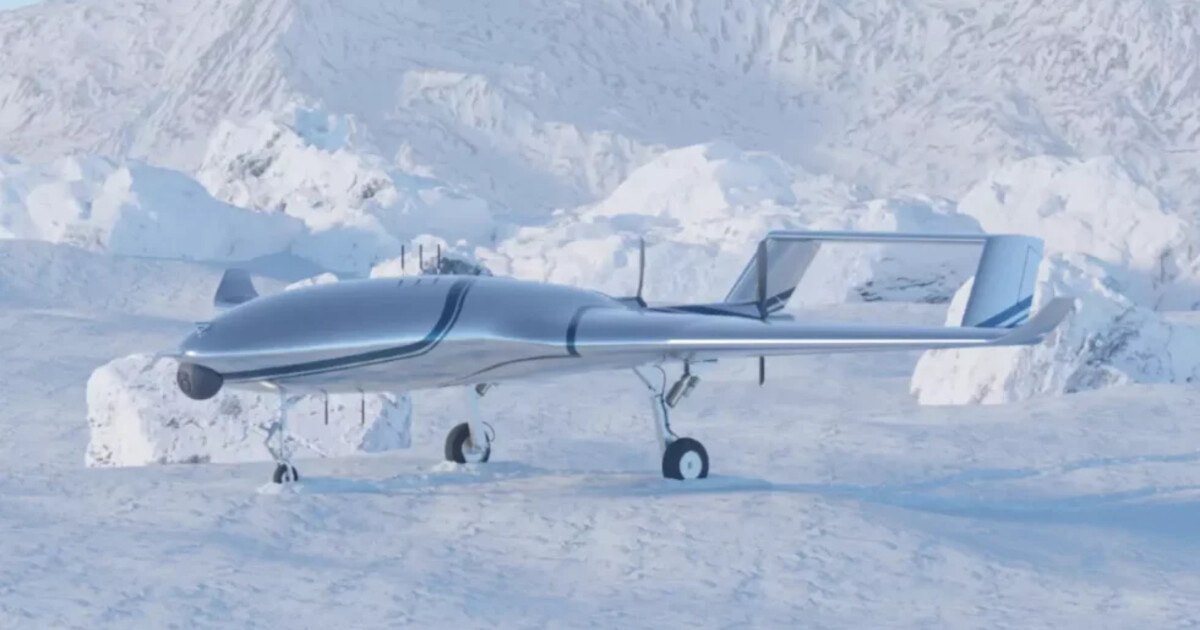
Cranfield Aerospace Solutions’ latest annual financial filing confirms the UK company has traded its hydrogen passenger aircraft ambitions for hydrogen-electric drones and will need to raise more money to keep developing them. In a strategic report filed with Companies House, the UK’s company registry, Cranfield’s directors describe a shift away from Project Fresson and “the zero emission passenger flight objective.”
Under Fresson, the company had worked to convert a nine-passenger Britten-Norman Islander to hydrogen fuel cell power, with backing from the UK’s Aerospace Technology Institute. Cranfield has instead shifted its focus toward Stingray, a family of hydrogen-electric, blended-wing-body drones.
The directors wrote that “new investment will be required” to develop Stingray, even though they expect the company’s non-research businesses to turn a profit. Over the next 12 months, the directors are counting on grant money the company expects to receive and further loans from existing shareholders.
“We continue to make progress on the program and will share developments publicly in due course,” a company spokesman told AIN. He added that Cranfield is also growing its aerospace consultancy and its Axsim motorsport simulator business. The spokesman did not say how the company plans to fund Stingray or which grants it expects to receive.
At the Dubai Airshow in November 2025, Cranfield unveiled the ST-5 as the smallest of four planned Stingray models. The company subsequently called off a planned June flight demonstration of the ST-5 demonstrator aircraft. In a June 11 email canceling the event, chief technology officer Paul Clarke told would-be attendees that the drone had completed its first flight test that week.
However, the company has not publicly announced a flight. The spokesman did not answer AIN’s questions about when or where the flight took place or what milestones the program has reached since.
Stingray marks a sharp turn from Cranfield’s plans as recently as mid-2024, when the company was raising money to finish building and testing a hydrogen-powered Islander demonstrator and bring the converted aircraft to market in 2027. In January 2025, German airline Evia Aero signed a letter of intent to buy 15 Islanders from Britten-Norman for conversion with Cranfield’s powertrain. Some of that Islander work carries over to Stingray, which uses Genesis, a modular hydrogen fuel cell powertrain developed under Fresson. The spokesman did not say what will become of the Islander demonstrator.
Cranfield ended its fiscal year in late September 2025 with £414,000 ($555,000) in cash and owed £13.4 million in convertible loans. Its shareholders, whose further loans the directors are counting on, have included HydrogenOne Capital Growth, Safran Corporate Ventures, Abu Dhabi’s Strategic Development Fund, and Motus Ventures.
In this article
More In Finance, Taxes, Insurance